The producer landscape
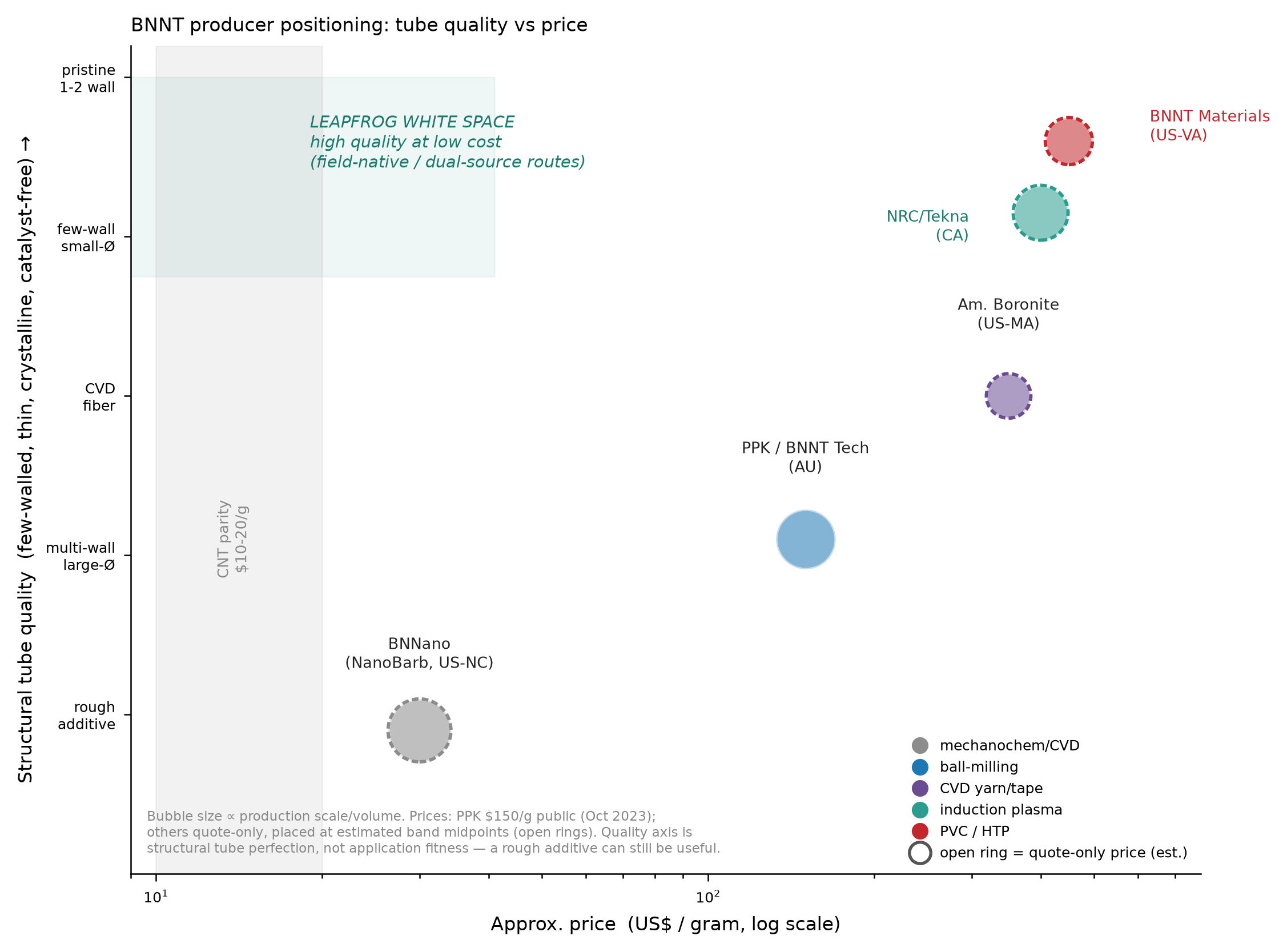
A handful of companies make BNNT commercially today, using fundamentally different processes that land them in very different places on the quality-versus-cost map. Here is who they are, what they make, and how they differ.
The producers
Descends from the pressurised vapor/condenser route developed in the NASA/Jefferson Lab lineage. Positions itself as the highest-quality material available: highly crystalline, few-walled, catalyst-free tubes. Quote-based pricing, low volume, high quality. bnnt.com ↗
The induction thermal plasma lineage — the pilot-scale route with the most credible path to kilogram quantities at good quality (few-walled, small-diameter tubes). The source of much recent mechanistic progress on nucleation and selectivity.
Commercialising the ball-milling-and-annealing (mechanochemical) route developed at Deakin University. The lowest openly-quoted price for high-quality-branded material (from around US$150/g, announced 2023), reflecting mechanochemical mass production — at the cost of more walls, larger diameters, and a purification burden. Company profile ↗
Makes "NanoBarb" — deliberately short, irregular, barbed tubes intended as a low-cost composite additive rather than pristine material. Low quality by design, at a cost the company describes as orders of magnitude below competitors. A distinct market position. bnnano.com ↗
Developing a continuous chemical-vapor-deposition process to make aligned BNNT yarns and tapes ("Superwire"), with defence-sector support and a focus on high-strength continuous fibre. boronite.com ↗
An emerging producer in the induction-plasma lineage, reported to have reached a BNNT production milestone aimed at semiconductor and aerospace supply. Increasingly listed as a direct competitor at the high-quality end.
Company positions are drawn from public sources and company statements; funding and headcount details, where mentioned elsewhere on this site, come from public aggregators and are indicative.