How BNNT is made
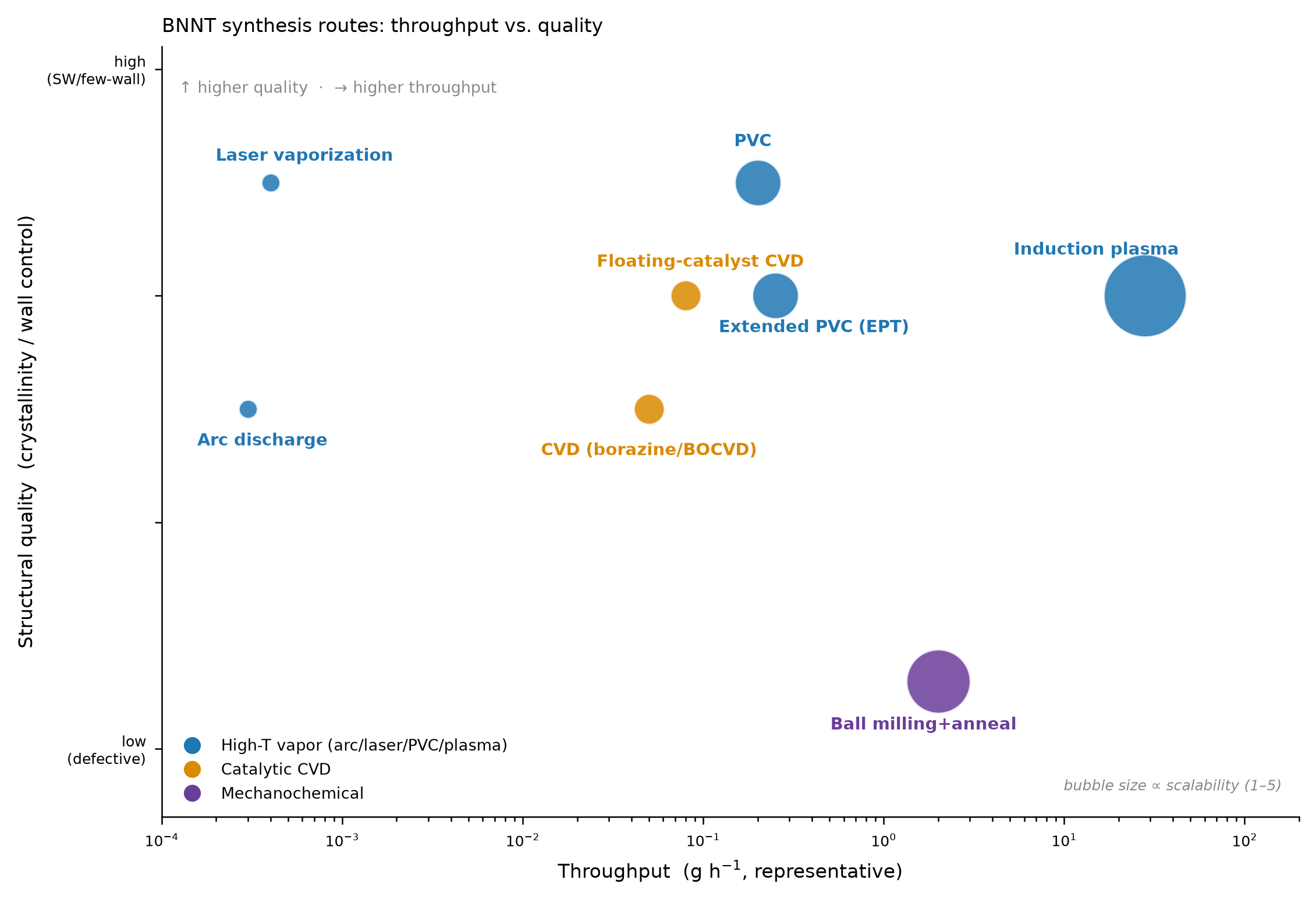
Every route to BNNT is a different answer to the same hard problem: boron nitride would rather form flat sheets than curved tubes, so making tubes selectively — and at a useful rate — is the central challenge. The methods below trade throughput against quality in very different ways.
The high-energy vapor routes
Arc discharge (1995)
The method that made the first BNNTs. An electric arc vaporises a boron-containing electrode; tubes condense from the vapor. High structural quality, but minute quantities — a laboratory discovery tool, not a production method.
Laser vaporization (1996)
A laser vaporises a boron nitride target, often under elevated pressure. Produces high-quality, few-walled tubes; like arc discharge it is intrinsically low-throughput and energy-intensive.
Pressurised Vapor/Condenser — PVC (2009)
A step-change for quality at usable rates: boron is vaporised and tubes grow in a controlled condensing vapor stream, catalyst-free, producing highly crystalline few-walled tubes. The lineage behind some of the highest-quality commercial material today.
The scalability frontier: induction thermal plasma
Demonstrated at pilot scale in 2014, an inductively-coupled thermal plasma sustains a large, hot reaction volume that can process boron feedstock continuously. This is currently the most credible route to kilogram-scale, good-quality BNNT, and much of the recent mechanistic progress — including 2026 work showing that tube selectivity is governed by the population of boron nucleation seeds — comes from this family.
Catalytic chemical vapor deposition (CVD)
Boron- and nitrogen-bearing gases (borazine, or boron oxide plus ammonia) react over a catalyst on a substrate. CVD offers control over where and how tubes grow and is the most common laboratory route. Recent work has pushed toward cheap mineral feedstocks (colemanite) and better-understood catalyst chemistry (titanium–boron–oxygen systems) to bring costs down.
Mechanochemical: ball-milling and annealing
Boron powder is milled for long periods to create a reactive, disordered precursor, then annealed under nitrogen to crystallise tubes. This is the most straightforwardly mass-producible route and underpins the lowest-cost commercial material — but the tubes are typically many-walled, larger in diameter, and less pure, requiring downstream purification.
Each route's founding and milestone papers are collected, with links, in the reference library.